Holiday Package Purchase Prediction
Overview
Built an end-to-end binary classification model using Random Forest to predict customer holiday package purchase behaviour — covering data cleaning, feature encoding, exploratory data analysis, model training, and evaluation.
Problem statement
"Trips & Travel.Com" wants to expand its customer base by offering a new Wellness Tourism Package. Historically, 18% of contacted customers purchased a package, but marketing costs were high because contacts were random. The goal is to use available customer data to predict which customers are likely to purchase a package and therefore make marketing spend more efficient.
Data collection
The dataset (20 columns, 4,888 rows) is sourced from Kaggle. Key columns include demographic information, contact/pitch details, income, number of previous trips, and whether the product was taken (ProdTaken).
Data cleaning & feature engineering
- Fixed inconsistent categorical labels (e.g.
Fe Male→Female,Single→Unmarried). - Imputed missing values: median for numeric columns (Age, DurationOfPitch, NumberOfTrips, MonthlyIncome), mode for categorical columns (TypeofContact, NumberOfFollowups, PreferredPropertyStar, NumberOfChildrenVisiting).
- Dropped
CustomerIDand createdTotalVisiting=NumberOfPersonVisiting+NumberOfChildrenVisiting. - Encoded categorical variables with label encoding prior to modeling.
Modeling
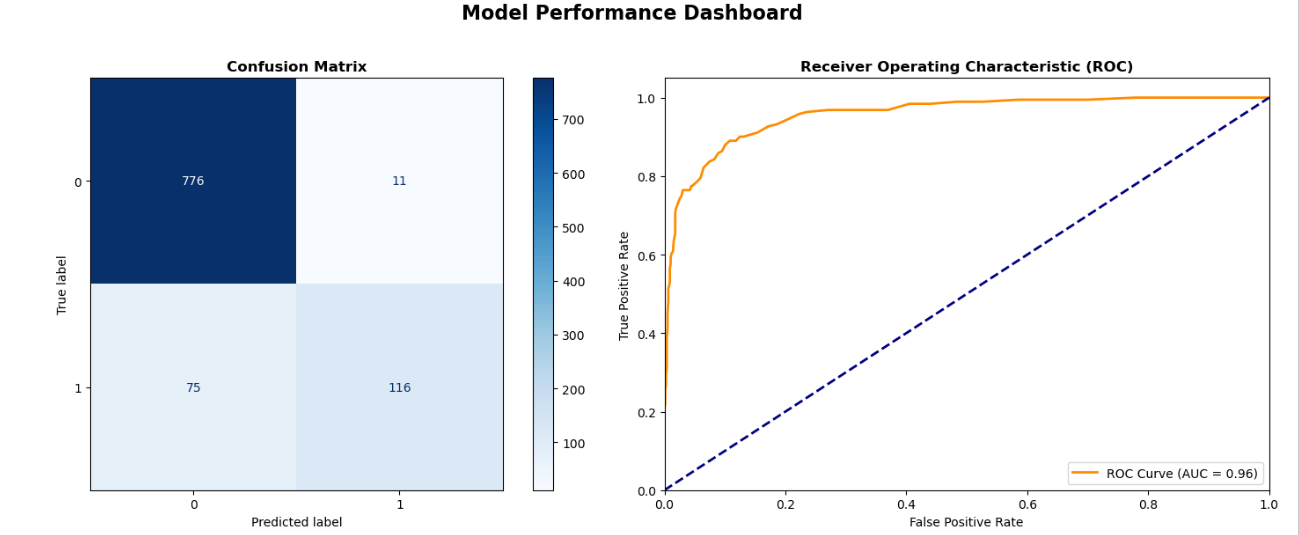
Used a Random Forest classifier with randomized hyperparameter search (RandomizedSearchCV) and cross-validation to find strong hyperparameters. Final model evaluated on a held-out test set with metrics including accuracy, precision, recall, F1 and ROC-AUC.
Key code (excerpt)
from sklearn.ensemble import RandomForestClassifier
from sklearn.model_selection import train_test_split, RandomizedSearchCV

X = df.drop(['ProdTaken'], axis=1)
y = df['ProdTaken']
X_train, X_test, y_train, y_test = train_test_split(X, y, test_size=0.2, random_state=42)

rf = RandomForestClassifier()
rf_params = {
    'n_estimators':[100,200,500,1000],
    'max_depth':[5,8,15,None,10],
    'max_features':[5,7,'auto',8],
    'min_samples_split':[2,8,15,20]
}
rand_search = RandomizedSearchCV(rf, rf_params, n_iter=50, cv=3, n_jobs=-1)
rand_search.fit(X_train, y_train)

best = rand_search.best_estimator_
# evaluate on test set and plot ROC
Highlights
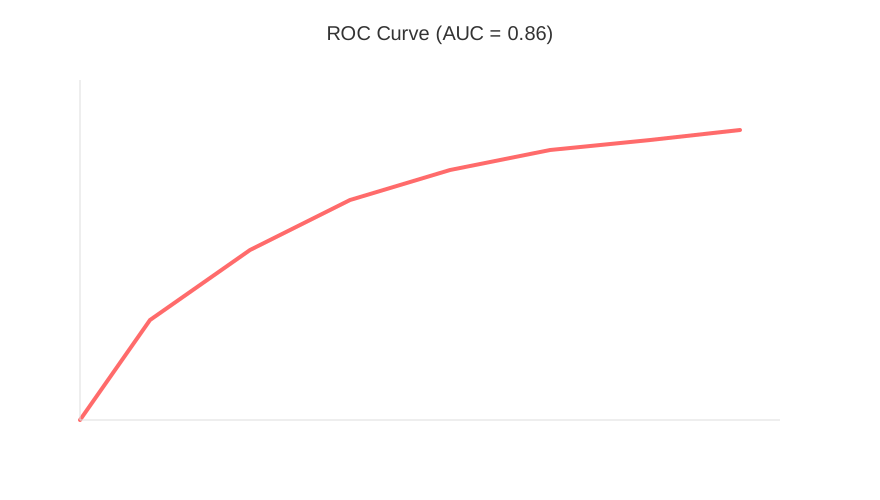
- Model ROC-AUC ≈ 0.86 (example result from validation).
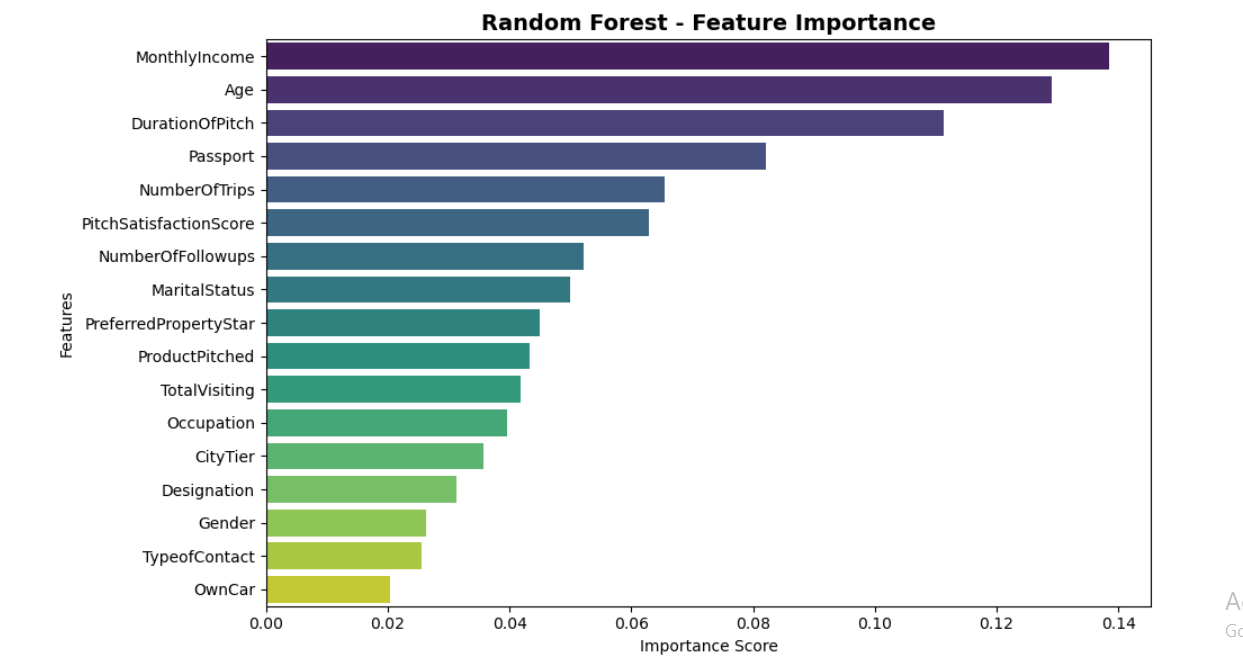
- Top predictors include Age, Income, and PastPurchases (see feature importance).
- Full reproducible notebook available on GitHub.